

Cookie Message in 2026: 7 Live Checks Before You Ship the Banner
A useful guide to cookie message should help readers understand both the rule and the behavior behind the rule. That is where consent topics become genuinely practical instead of sounding like recycled compliance copy.
The practical review for cookie message starts when you look past the banner copy and test the live behavior. That is usually where teams find the real gaps: tags firing too early, weak refusal flows, and settings that drift after routine site changes.
The official guidance still points in the same direction. The ICO now frames cookies, pixels, scripts, tags, and similar tools under the broader label “storage and access technologies.” CNIL still says “rejecting cookies should be just as easy as accepting them.” Your Europe still reminds businesses that “Not all cookies require your consent.” And California’s Department of Justice still describes Global Privacy Control as a “stop selling or sharing my data switch.”
If you want the nearest companion reads first, start with these guides to cookie notice, cookie policy popup, and what is a cookie policy. This page stays narrower. It is the cookie message review I would use this week before approving banner copy, a CMP rollout, or a design refresh.
If your team is trying to get cookie message under control without adding a heavyweight privacy stack, DataShyre can help. DataShyre focuses on consent and preference management that are easier to implement, easier to operate, and easier to trust on a live site. Start with DataShyre’s consent and preference management or book a demo.
If your team needs the banner text, consent logic, privacy notice, and runtime behavior to line up, DataShyre can help with consent management, data mapping, and implementation cleanup. The expensive problem is rarely only bad wording. It is a message that promises one thing while the live site does another.
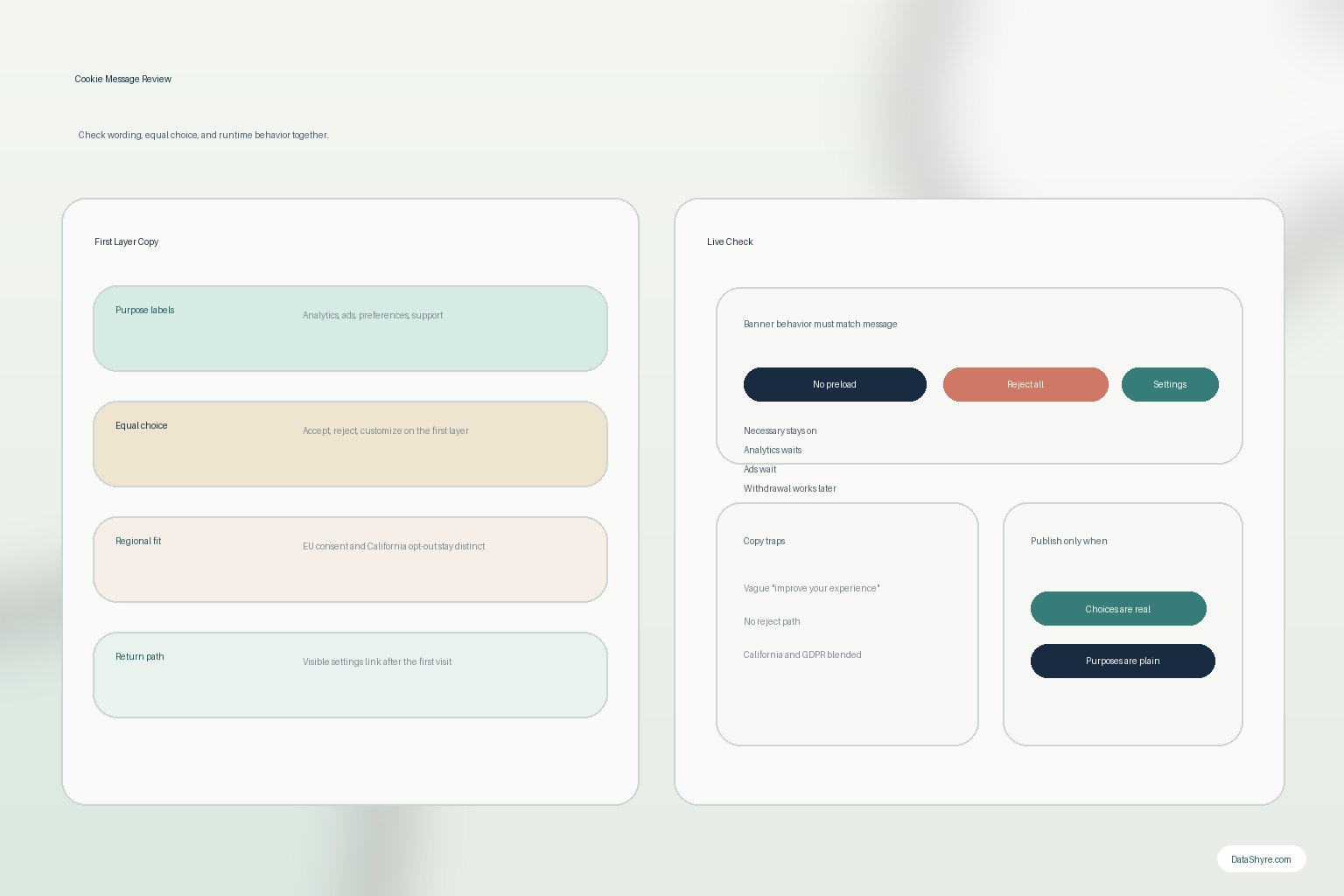
1. Start with the live technologies before you write the message
The first cookie message mistake is treating copy as the main product.
It is not.
The message is the visible summary of a deeper control layer:
- what loads before the person clicks anything;
- which technologies are necessary versus optional;
- which third parties receive data;
- how users refuse, customize, or revisit choices later; and
- which jurisdictions the site is actually serving.
If nobody on the team can answer those questions quickly, the cookie message usually becomes a polite guess.
2. Classify necessary and optional uses before you label anything
This is the fastest useful check for a cookie message.
Your Europe still states the high-level rule clearly: consent is generally required before using cookies, but some cookies used only to transmit a communication or provide an online service explicitly requested by the user do not need consent.
This is why a careful cookie message review should separate:
- authentication and session continuity;
- cart and checkout state;
- fraud or security controls;
- analytics and measurement;
- advertising or cross-site tracking;
- personalization and preference features;
- third-party embeds or support tools.
If analytics, advertising, or convenience features get labeled necessary just because the draft is vague, the rest of the message starts misleading people immediately.
3. Make the first layer reflect a real choice
Many cookie message failures are visible in the first five seconds.
The ICO’s current guidance says the mechanism should make it as easy to refuse consent as to accept it, and that consent needs a positive action before non-exempt technologies are set. CNIL’s enforcement messaging is equally blunt: rejecting cookies should be as easy as accepting them.
So a defensible cookie message should check whether:
Accept allandReject allare both available when consent is the legal basis;- the reject path is not hidden behind an extra detour;
- the button color, size, or placement does not heavily push acceptance;
- the same balance still works on mobile;
- silence or continued browsing is not treated as consent.
If the interface offers a choice in theory but the design pressures acceptance in practice, the message is not doing honest work.
4. Explain the purposes in plain language, not in polished blur
This is where many cookie message drafts still sound nice while saying almost nothing.
We use cookies to improve your experience is not always false, but it is often too vague to help a person understand what is really happening.
The better cookie message questions are:
- does the person understand whether analytics, advertising, personalization, or support tooling is involved;
- do they know whether another company receives data;
- can they see where fuller details and settings live;
- do the categories in the banner still match the real vendors and runtime behavior.
If the site uses analytics, pixels, ad tech, or embedded services, the message should say enough for the person to understand the categories without reading like a scanner export.
Ireland’s Data Protection Commission still answers the analytics question directly: analytics cookies need consent. That is one reason a good cookie message should not hide analytics behind soft language that makes it sound automatically exempt.
5. Do not blur EU-style consent with California opt-out rights
This is one of the most common cookie message mistakes on U.S.-facing sites.
California’s Department of Justice describes Global Privacy Control as a “stop selling or sharing my data switch.” That matters because the California user action is often an opt-out of sale or sharing, not the same thing as consent for optional technologies under EU- or UK-style rules.
So a stronger cookie message review asks whether the interface clearly separates:
- consent to optional analytics or advertising technologies where required;
- opt-out of sale or sharing where California law applies;
- access to a broader privacy notice;
- later preference changes or rights links such as
Your Privacy Choices.
If one banner implies all of those rights are handled automatically, it may be promising more than the implementation really supports.
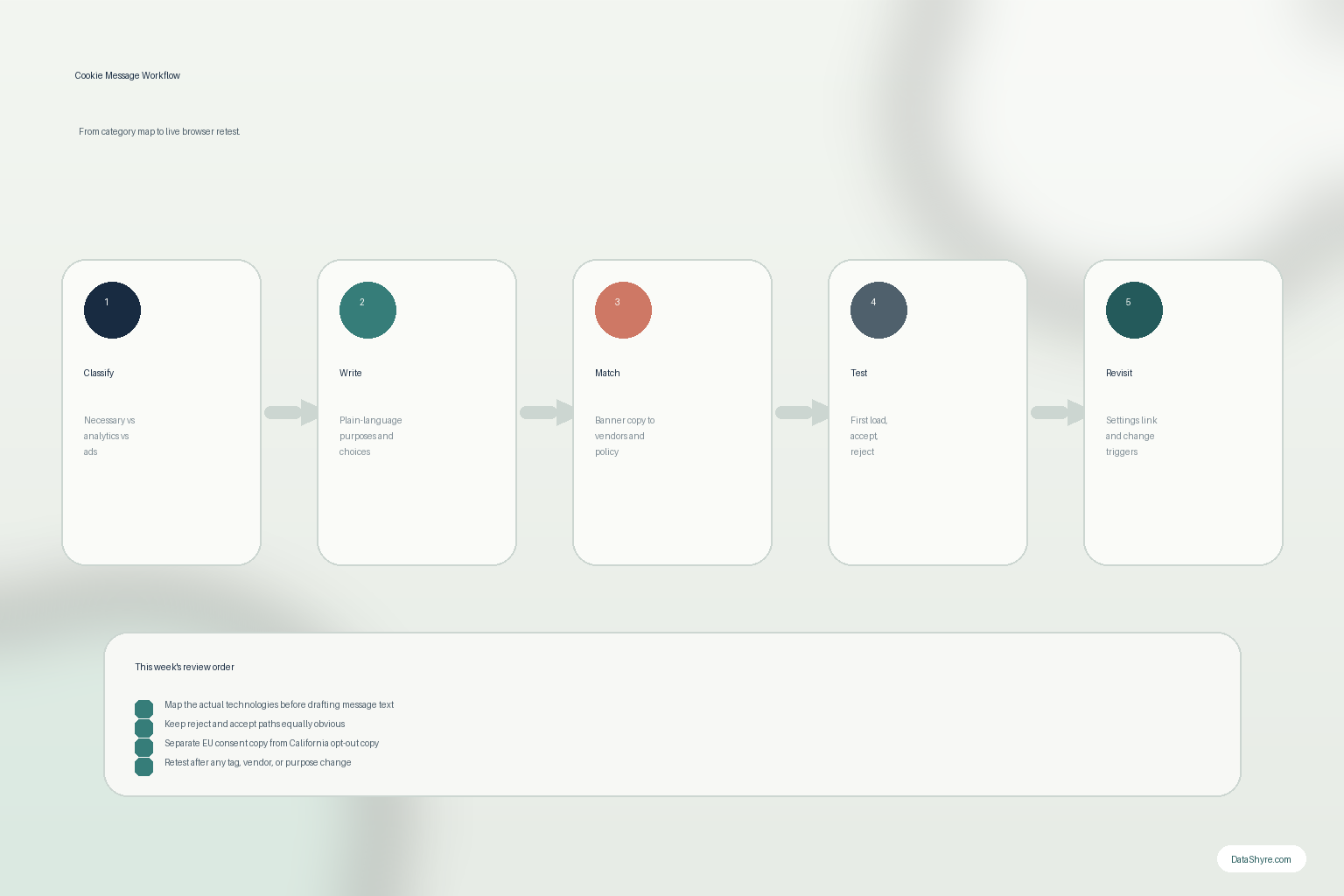
6. Verify that the message changes the runtime, not only the screen
A clean-looking cookie message can still be decorative if the browser trace tells a different story.
The real check is not only that the banner appears. It is whether the live site behaves differently when the person:
- does nothing;
- rejects optional technologies;
- accepts them;
- reopens settings later and changes the choice.
If optional analytics, ad scripts, or pixels still load before consent or keep loading after withdrawal, the message is not aligned with the system it describes.
This is also where DataShyre implementation help tends to matter most. The hard part is often tracing what the CMP, tag manager, plugins, embeds, and custom code actually do at each state change.
7. Re-review the cookie message whenever the stack or purpose changes
The long-term cookie message failure is not always the first launch.
It is drift.
The ICO’s current guidance says that if you introduce new storage and access technologies for a different purpose than what was originally stated when consent was granted, you must obtain fresh consent for the new technology or purpose.
That means a practical cookie message review should rerun whenever:
- a new analytics, advertising, or support vendor is added;
- a new page template introduces a different embed or script;
- the team changes the purposes listed in the banner;
- the privacy policy or vendor list changes;
- the regional rollout changes which legal model applies.
If those events do not trigger review, the message usually becomes inaccurate long before anyone updates the copy.
A practical cookie message review for this week
If I were checking a live cookie message today, I would use this order:
- map the actual technologies and markets first;
- classify necessary versus optional uses;
- rewrite vague purpose labels into plain language;
- check that
Reject allis as obvious asAccept all; - separate consent language from California opt-out language;
- test the runtime before choice, after choice, and after withdrawal;
- tie future review to vendor, tag, or purpose changes.
That order catches more real problems than polishing the first sentence of the banner.
FAQ
Is a cookie message the same thing as a cookie notice?
Usually people mean very similar things. In real deployments, the cookie message is the first-layer text and control surface people see, while the wider notice and policy layers provide the fuller explanation and settings.
Do all cookie messages need a Reject all button?
If you are relying on consent for optional technologies, the current regulator direction strongly favors making refusal as easy as acceptance. That is the safer working assumption for most modern implementations.
Can one cookie message handle GDPR and California at the same time?
It can help route people, but it should not flatten different legal actions into one vague button set. EU- and UK-style consent flows and California opt-out rights often need distinct logic even if they share part of the same interface.
Bottom line
The best cookie message in 2026 is not the one that sounds friendliest.
It is the one that:
- describes the real technologies in use;
- gives people a real refusal path;
- explains purposes in plain language;
- keeps California opt-out logic distinct where needed; and
- stays aligned with the runtime after the next release.
If those checks pass, the message earns trust.
Seen clearly, cookie message is less about a pop-up and more about whether the site behaves honestly after the visitor makes a choice.
Official sources used
- ICO, Guidance on the use of storage and access technologies: https://ico.org.uk/for-organisations/direct-marketing-and-privacy-and-electronic-communications/guidance-on-the-use-of-storage-and-access-technologies/
- ICO, How do we manage consent in practice?: https://ico.org.uk/for-organisations/direct-marketing-and-privacy-and-electronic-communications/guidance-on-the-use-of-storage-and-access-technologies/how-do-we-manage-consent-in-practice/
- Your Europe, Data protection and online privacy: https://europa.eu/youreurope/citizens/consumers/internet-telecoms/data-protection-online-privacy/indexamp_en.htm
- CNIL, Dark Patterns in Cookie Banners: https://www.cnil.fr/en/dark-patterns-cookie-banners-cnil-issues-formal-notice-website-publishers
- Data Protection Commission, Do I need consent for analytics cookies?: https://www.dataprotection.ie/en/faqs/cookies/do-i-need-consent-analytics-cookies
- California Department of Justice, Global Privacy Control: https://oag.ca.gov/privacy/ccpa/gpc