

GDPR Compliance Website in 2026: 7 Live Checks Before You Call a Site Ready
A useful guide to gdpr compliance website should help readers understand both the rule and the behavior behind the rule. That is where consent topics become genuinely practical instead of sounding like recycled compliance copy.
The practical review for gdpr compliance website starts when you look past the banner copy and test the live behavior. That is usually where teams find the real gaps: tags firing too early, weak refusal flows, and settings that drift after routine site changes.
It is closer to ready when the live collection points, disclosures, consent controls, analytics behavior, vendor scripts, and rights paths all tell the same story.
That is also where the current official sources keep pointing. On March 19, 2026, the European Data Protection Board launched its 2026 Coordinated Enforcement Framework on “transparency and information obligations” under GDPR Articles 12, 13, and 14. Article 12 itself still requires information to be delivered in “clear and plain language.” The UK’s ICO finalized its guidance on “storage and access technologies” on April 29, 2026, which is a better fit for real websites than old cookie-only shorthand. Ireland’s Data Protection Commission still says analytics cookies need consent and that users must be able to “withdraw or vary their consent” at any time. CNIL’s banner enforcement materials still say rejecting cookies should be “just as easy as accepting them.”
If you want the nearest companion reads first, start with these guides to gdpr requirements, gdpr compliant, and website privacy checker. This page stays narrower. It is the gdpr compliance website review I would use this week before signing off a live build.
If your team is trying to get gdpr compliance website under control without adding a heavyweight privacy stack, DataShyre can help. DataShyre focuses on consent and preference management that are easier to implement, easier to operate, and easier to trust on a live site. Start with DataShyre’s consent and preference management or book a demo.
If your team wants help turning a privacy policy, consent interface, and runtime behavior into one coherent website control layer, DataShyre can help with consent management, data mapping, and implementation review. Most website GDPR problems are not writing problems. They are mismatch problems.
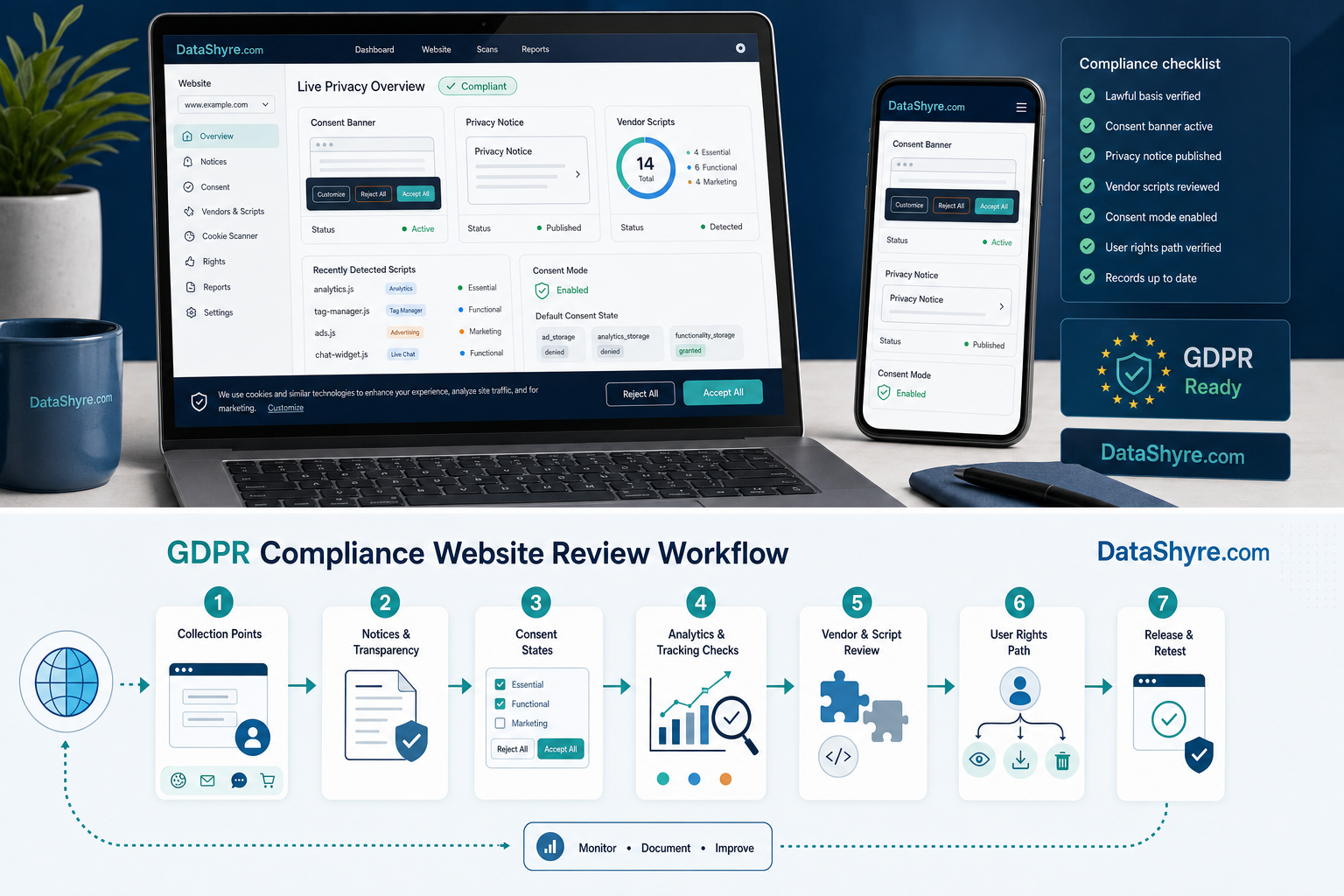
1. Start with the pages that actually collect or trigger data
The first gdpr compliance website mistake is auditing only the homepage.
For many sites, the riskier journeys are elsewhere:
- demo or contact forms;
- newsletter and download forms;
- checkout or account registration pages;
- support widgets or chat tools;
- embedded video, map, or social components; and
- landing pages loaded with ad-tech and analytics.
That matters because GDPR transparency duties do not attach only to the page with the prettiest footer. They attach where personal data is actually collected or processing starts.
So the first useful gdpr compliance website step is to map the real journeys where a person can be identified, tracked, profiled, or handed to a vendor.
2. Check whether the notice arrives at the point of collection
Many teams still treat the website privacy policy as the whole notice layer.
It is not.
GDPR Article 13 is still about information provided when personal data is collected from the individual. Article 12 still requires that information to be concise, transparent, intelligible, easily accessible, and in “clear and plain language.”
For a live gdpr compliance website review, that means asking:
- does the person see the right notice when they submit a form;
- is the relevant disclosure reachable on mobile without hunting through the footer;
- do the short notices and the full policy actually match;
- are purposes and recipients described clearly enough to be useful; and
- does each collection point tell the same story as the underlying workflow.
If the notice shows up only after submission, or only in generic footer text that hides the actual purpose, the site is weaker than it looks.
3. Treat website consent as a runtime control, not a design asset
This is where a lot of gdpr compliance website work still collapses.
The ICO’s current guidance explicitly covers cookies, pixels, fingerprinting, web storage, scripts, and tags under the broader label “storage and access technologies.” That means a modern website review should test what actually loads or reads from the device before the person chooses, not only whether a banner exists.
The practical checks are blunt:
- what fires on first load in a clean browser;
- what changes after
Reject all; - what changes after
Accept all; - whether withdrawal later actually changes future behavior; and
- whether the cookie table, vendor list, and banner categories still match the live runtime.
If optional technologies already run before consent, the gdpr compliance website problem is technical before it is editorial.
4. Do not treat analytics cookies as automatically harmless
This is one of the easiest places for a polished site to drift into false confidence.
Ireland’s Data Protection Commission still answers the question directly: “Do I need consent for analytics cookies?” Yes.
That matters because many teams still label website analytics as low-risk housekeeping and move on.
A stronger gdpr compliance website review asks:
- whether analytics cookies or identifiers load before choice;
- whether first-party and third-party analytics have been separated clearly;
- whether the analytics vendor also uses data for its own purposes;
- whether the disclosure language describes the measurement honestly; and
- whether the team can prove the consent state changed the analytics behavior.
If the implementation treats analytics as exempt by habit, the site may already be out of step with current regulator guidance.

5. Make refusal and withdrawal genuinely easy
Consent is not valid because there is an Accept button somewhere on the page.
Ireland’s DPC says users must be able to “withdraw or vary their consent” at any time and that it must be as easy to withdraw as to give it. CNIL’s banner enforcement language is even shorter: rejecting cookies should be “just as easy as accepting them.”
So for gdpr compliance website work, I would check whether:
Reject allis available with comparable prominence where relevant;- category-level choices are understandable;
- a later settings path is visible and works on every page template;
- consent changes propagate to tag managers, embeds, and vendors; and
- the withdrawal path is still usable on mobile.
If refusal is hidden, delayed, or visually downgraded, the problem is not subtle.
6. Review third-party scripts, embeds, and processors like part of the site
Website teams often talk about GDPR compliance as if the site were only first-party HTML and forms.
That view is outdated.
The live website usually includes analytics tools, ad tags, consent tools, support widgets, video embeds, fonts, maps, A/B testing, CRM connectors, and plugins. A credible gdpr compliance website review should therefore connect:
- the visible page behavior;
- the processor or vendor behind that behavior;
- the purpose the team claims it serves;
- the notice or consent route tied to it; and
- the contract or transfer logic that supports it.
If your team is unsure which scripts, vendors, and disclosures still belong together, DataShyre can help bridge the gap between the public website layer and the real processing map underneath it.
7. Re-test the website whenever the release changes the data path
The biggest gdpr compliance website failure is not always the original launch.
It is drift.
A new popup goes live. Marketing adds another pixel. Product changes registration fields. Support installs a new chat tool. A CMP category changes. A new embedded provider appears on only one template. The policy and banner still look respectable, but the live behavior is no longer the same site you reviewed last month.
This is why a serious gdpr compliance website process should re-run after:
- new form launches;
- tag-manager changes;
- vendor or plugin additions;
- analytics or advertising changes;
- template or CMS changes; and
- policy or consent-language edits.
If the review is not tied to release change, it usually becomes a screenshot archive instead of a control.
A practical GDPR compliance website review for this week
If I were pressure-testing a gdpr compliance website today, I would use this order:
- map the pages and components that collect data or trigger tracking;
- verify point-of-collection notice and policy alignment;
- test first-load, reject, accept, and withdrawal behavior in a clean browser;
- isolate analytics and other non-essential technologies to confirm they wait for consent where required;
- compare the live runtime against the banner categories, cookie explanation, and vendor disclosures;
- review whether refusal and later preference changes are easy on desktop and mobile; and
- re-run the checks after any release that changes forms, vendors, scripts, or templates.
That sequence tells you much more than asking whether the banner looks compliant.
FAQ
Is a privacy policy enough for GDPR website compliance?
No. A privacy policy is only one part of the transparency layer. The website also needs accurate collection-point notice, working consent controls where relevant, usable rights paths, and runtime behavior that matches the public explanation.
Do analytics cookies still need consent on a GDPR-facing website?
Yes in the current Irish DPC guidance. That is one reason a website review should test analytics behavior directly instead of assuming measurement is automatically exempt.
What is the most common GDPR website failure?
Mismatch. The banner says one thing, the policy says another, and the runtime shows something else.
Bottom line
The best gdpr compliance website review in 2026 is not a wording review alone.
It is a live-systems review that checks where data is collected, what the person is told, what technologies actually run, how refusal works, which vendors are involved, and whether the site changed since the last audit.
If those pieces line up, the website is far closer to defensible.
Seen clearly, gdpr compliance website is less about a pop-up and more about whether the site behaves honestly after the visitor makes a choice.
Sources
- EUR-Lex, Regulation (EU) 2016/679 (GDPR), including Articles 12 to 14: https://eur-lex.europa.eu/legal-content/EN/TXT/?uri=CELEX:32016R0679
- European Data Protection Board, CEF 2026 launch on transparency and information obligations under the GDPR: https://www.edpb.europa.eu/news/cef-2026-edpb-launches-coordinated-enforcement-action-on-transparency-and-information_da
- European Commission, Information for individuals: https://commission.europa.eu/law/law-topic/data-protection/information-individuals_en
- ICO, Final storage and access technologies guidance published: https://ico.org.uk/about-the-ico/media-centre/news-and-blogs/2026/04/final-storage-and-access-technologies-guidance-published/
- ICO, Guidance on the use of storage and access technologies: https://ico.org.uk/for-organisations/direct-marketing-and-privacy-and-electronic-communications/guidance-on-the-use-of-storage-and-access-technologies/
- Data Protection Commission, My website or app uses cookies and other tracking – do I have to get consent from users?: https://dataprotection.ie/en/faqs/cookies/my-website-or-app-uses-cookies-and-other-tracking-do-i-have-get-consent-users
- Data Protection Commission, Do I need consent for analytics cookies?: https://www.dataprotection.ie/en/faqs/cookies/do-i-need-consent-analytics-cookies
- CNIL, Dark Patterns in Cookie Banners: CNIL issues formal notice to website publishers: https://www.cnil.fr/en/dark-patterns-cookie-banners-cnil-issues-formal-notice-website-publishers