

Writing a Privacy Policy in 2026: 7 Live Checks Before You Publish
A useful guide to writing a privacy policy should help readers understand both the rule and the behavior behind the rule. That is where consent topics become genuinely practical instead of sounding like recycled compliance copy.
The practical review for writing a privacy policy starts when you look past the banner copy and test the live behavior. That is usually where teams find the real gaps: tags firing too early, weak refusal flows, and settings that drift after routine site changes.
The real job is turning the live collection, tracking, sharing, and rights behavior of the business into a page normal people can understand and teams can keep accurate after the next release.
That is where the current official sources still line up. The California Privacy Protection Agency’s regulations effective January 1, 2026 say the purpose of the privacy policy is to give consumers a “comprehensive description” of a business’s online and offline information practices and the information needed to exercise their rights. GDPR Article 12 still requires privacy information in “clear and plain language.” California’s Department of Justice still says a business’s privacy policy should be “updated at least once a year.” WordPress still reminds site owners it is their responsibility to keep policy information “current and accurate.” And the ICO’s final April 2026 guidance now uses the broader label “storage and access technologies,” which is a better fit for the cookies, pixels, scripts, and similar tools real websites use now.
If you want nearby companion reads first, start with these guides to create privacy policy, privacy policy template, and privacy statement for website. This page stays focused on writing a privacy policy itself: how to turn the messy real stack into a readable, reviewable, publishable page this week.
If your team is trying to get writing a privacy policy under control without adding a heavyweight privacy stack, DataShyre can help. DataShyre focuses on consent and preference management that are easier to implement, easier to operate, and easier to trust on a live site. Start with DataShyre’s consent and preference management or book a demo.
If your team needs help connecting the written policy to the systems behind it, DataShyre can help with data mapping, consent management, and DSR automation. The hard part is rarely writing a paragraph. It is proving the paragraph is still true after forms, tags, plugins, or vendors change.
1. Start writing from the live data map, not from the page outline
The first writing a privacy policy failure is using the document to discover the business instead of using the business to inform the document.
That reverses the order.
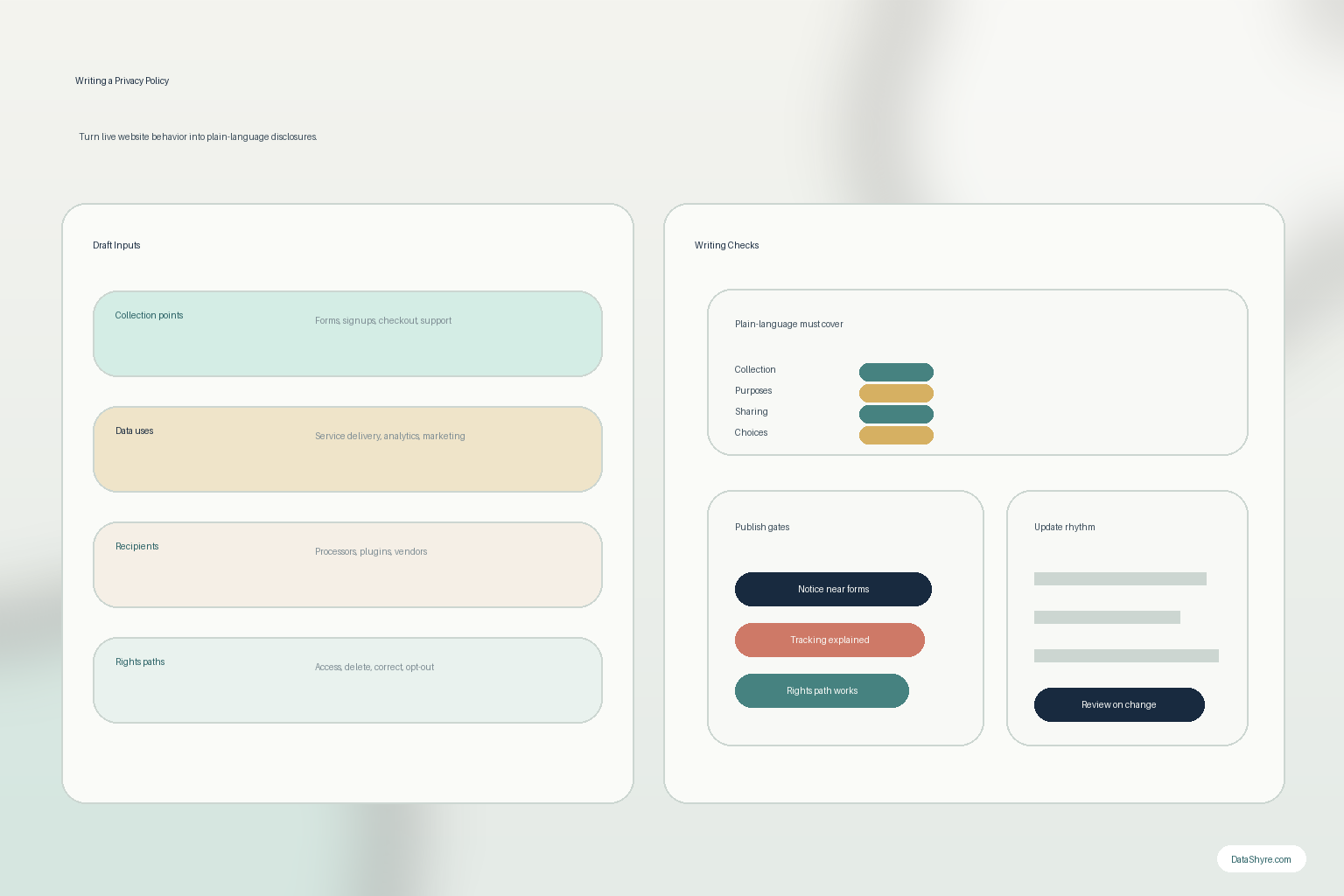
Before you write, inventory:
- every form, signup, quote, checkout, support, and app flow that collects personal information;
- the categories of personal information each flow collects;
- the systems, vendors, or processors that receive the data;
- the cookies, pixels, SDKs, embeds, and analytics tied to those journeys; and
- the rights, privacy settings, or opt-out controls users are promised later.
If that inventory is incomplete, the page usually becomes polished fiction.
2. Write the required disclosure blocks before you polish the tone
Many writing a privacy policy projects spend too much time on the opening paragraph and not enough time on the sections people actually need.
The current California regulations still expect a privacy policy to provide a meaningful description of online and offline information practices. In real deployments, that means your draft usually needs clear sections for:
- categories of personal information collected;
- sources of that information;
- business or commercial purposes for using it;
- categories of third parties or service providers receiving it;
- retention periods or the criteria used to decide them;
- privacy rights available in scope; and
- how people can exercise those rights or contact the business.
GDPR-facing teams usually need the same structure plus the GDPR-specific pieces around legal basis, recipients, transfers where relevant, and data-subject rights.
So for writing a privacy policy, structure is not a formatting choice. It is the control that stops the page from leaving out the most important facts.
3. Use plain language where the user actually makes decisions
This is where a lot of writing a privacy policy work goes wrong.
The draft sounds formal, but the person reading it cannot tell what the business actually does.
That matters because GDPR Article 12 still requires “clear and plain language.” A good policy does not only name categories and rights. It makes them understandable where they matter:
- what the business collects;
- why it collects it;
- who receives it;
- how long it stays;
- what controls the person has; and
- where to go next.
If a normal reader has to decode legal filler before they can understand the collection, sharing, or settings path, the writing is already weaker than it needs to be.
4. Do not treat the policy page as a substitute for notice at collection
This is one of the easiest writing a privacy policy mistakes to miss.
The page in the footer matters, but it is not the only notice moment that matters.
California’s current CCPA guidance still says a notice at collection must appear at or before collection and must link to the privacy policy for a fuller description of the business’s practices and privacy rights. So while writing a privacy policy, you should also check whether:
- contact, demo, lead, download, and newsletter forms expose the right notice nearby;
- mobile layouts keep that notice visible;
- the short notice and the full policy tell the same story;
- the landing page or app download flow links to the policy where required; and
- the user can reach the relevant section without hunting.
If the policy says all the right things but the person only sees the disclosure after submission, the writing arrived too late to do its job.
5. Write cookies, pixels, and similar tracking like they really exist
Weak writing a privacy policy projects still describe data collection as if the only input is what people type into forms.
That is not how most live sites work anymore.
The ICO’s final April 2026 guidance uses the broader label “storage and access technologies.” That matters because it reflects reality better than a narrow cookie-only frame. Your policy writing should usually account for:
- cookies and web storage;
- analytics tags and scripts;
- pixels and event beacons;
- embedded tools like chat, maps, video, and schedulers; and
- any third party receiving browser or device data through those tools.
That does not mean dumping a scanner export into the middle of the page.
It means not pretending the site is form-only when the runtime clearly is not.
6. For WordPress, use generated helper text as input, not as the final answer
This is one of the clearest writing a privacy policy checks for WordPress teams.
WordPress provides privacy settings and guidance, but WordPress is also explicit that it is the site owner’s responsibility to keep the final information “current and accurate.” The Plugin Handbook still says plugins that collect, use, store, or pass user data to third parties should add suggested privacy text for administrators.
That is useful, but it is not the finished page.
For writing a privacy policy on a WordPress stack, compare the draft against:
- the active plugins and themes in production;
- forms, ecommerce, booking, and support flows;
- consent or cookie tools running beside them;
- any custom code, scripts, or embeds outside plugin helper text; and
- the real rights or settings paths users will rely on later.
If your team is trying to reconcile WordPress helper text, plugin behavior, and live tracking into one truthful page, DataShyre can help connect the operational side before the published copy drifts out of sync.
7. Finish the writing process with an update trigger, not only a publish date
California’s Department of Justice still says the privacy policy should be “updated at least once a year.”
That is a floor, not a strategy.
The better writing a privacy policy habit is to re-review the page when:
- a new form, field, or app flow goes live;
- a new processor, vendor, or embed is added;
- the business starts using data for a new purpose;
- the rights workflow changes;
- the cookie or preference layer changes; or
- a platform update changes what is collected or where it goes.
That is how the writing stays defensible after publication.
A practical writing-a-privacy-policy order for this week
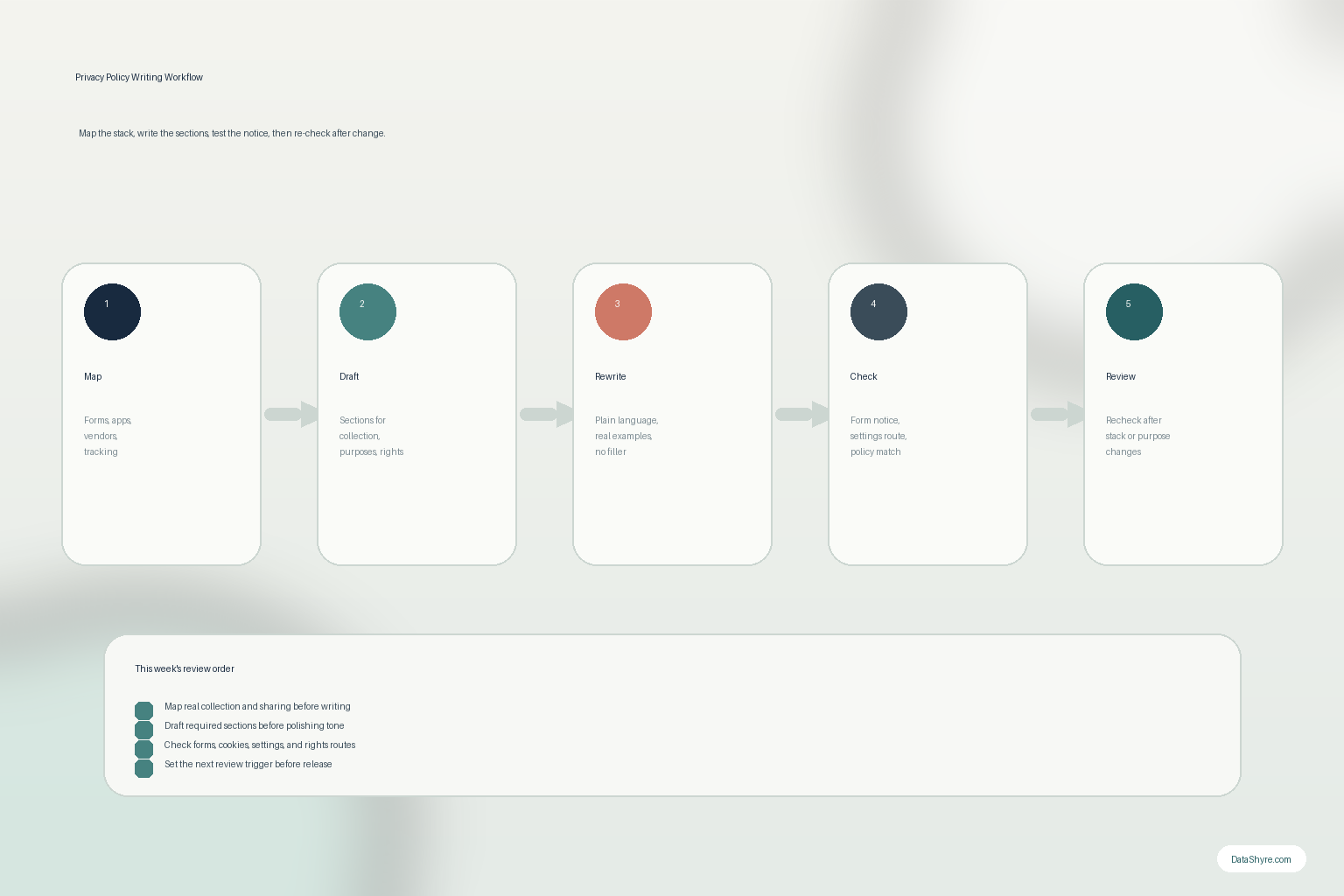
If I were writing a privacy policy today, I would use this order:
- map the live collection, sharing, tracking, and rights flows;
- draft the required sections before polishing the opening;
- rewrite every vague purpose statement into plain language;
- check notice-at-collection links on every collection surface;
- verify the tracking explanation against the live runtime;
- compare WordPress or platform helper text against the actual stack; and
- set the next update trigger before the next release.
That order gets you closer to a truthful page than starting with a generic policy shell.
FAQ
What should I gather before writing a privacy policy?
Gather your collection points, the data categories involved, the purposes, the vendors or processors receiving the data, your tracking tools, your rights workflow, and your retention logic.
Can I finish writing a privacy policy from a generator alone?
You can start there, but you should not stop there. A generator can suggest structure. It cannot verify the real forms, vendors, scripts, and rights paths already running on the live site.
Does writing a privacy policy also mean writing about cookies?
Usually yes. If the site uses cookies, pixels, tags, or similar tracking technologies, the policy should explain them honestly or clearly point to the related cookie or preference layer without contradiction.
Bottom line
The best writing a privacy policy process in 2026 is not the one that produces the fastest draft.
It is the one that starts from the real stack, writes the essential sections clearly, puts notice where collection happens, explains tracking honestly, keeps WordPress helper text in perspective, and forces review when the system changes.
Seen clearly, writing a privacy policy is less about a pop-up and more about whether the site behaves honestly after the visitor makes a choice.