

GDPR Cookie Policy Template in 2026: 7 Live Checks Before You Publish
A useful guide to gdpr cookie policy template should help readers understand both the rule and the behavior behind the rule. That is where consent topics become genuinely practical instead of sounding like recycled compliance copy.
The practical review for gdpr cookie policy template starts when you look past the banner copy and test the live behavior. That is usually where teams find the real gaps: tags firing too early, weak refusal flows, and settings that drift after routine site changes.
The useful job is turning the template into a truthful explanation of what your site actually stores, reads, triggers, shares, and lets the user change later.
That is still where the official sources line up. GDPR Article 12 requires privacy information in “clear and plain language.” Your Europe still says that if cookies require consent, users need “clear and comprehensive information” about the cookies and their purpose, and it must be “as easy for your users to withdraw” consent as to accept it. Ireland’s DPC is even more direct that the information in the cookie policy must describe the operator’s own deployment and use of cookies, not a generic third-party explainer. And the ICO’s final April 2026 guidance uses the broader label “storage and access technologies” and explicitly reaches “scripts and tags” as well as classic cookies.
If you want the closest companion reads first, start with these guides to cookie policy template, european cookie law, and cookie policy example. This page stays narrower. It is the gdpr cookie policy template review I would use this week before publishing one on a live EU-facing site.
If your team is trying to get gdpr cookie policy template under control without adding a heavyweight privacy stack, DataShyre can help. DataShyre focuses on consent and preference management that are easier to implement, easier to operate, and easier to trust on a live site. Start with DataShyre’s consent and preference management or book a demo.
If your first draft comes from a law-firm sample, a OneTrust or Cookiebot export, or an old internal boilerplate, DataShyre can help connect the written policy to the real banner logic, vendor behavior, and runtime evidence through consent management, data mapping, and implementation support. The hard part is rarely getting a template. It is proving the template still describes the live site.
1. Treat the template as a draft shell, not the source of truth
The first gdpr cookie policy template mistake is assuming the template already knows your website.
It does not.
It does not know:
- which scripts or tags fire on first load;
- which third parties receive browser or device data;
- which categories are actually necessary;
- which tools only run after consent; or
- whether the withdrawal path still works on mobile.
So the template is the shell.
The live runtime is the truth.
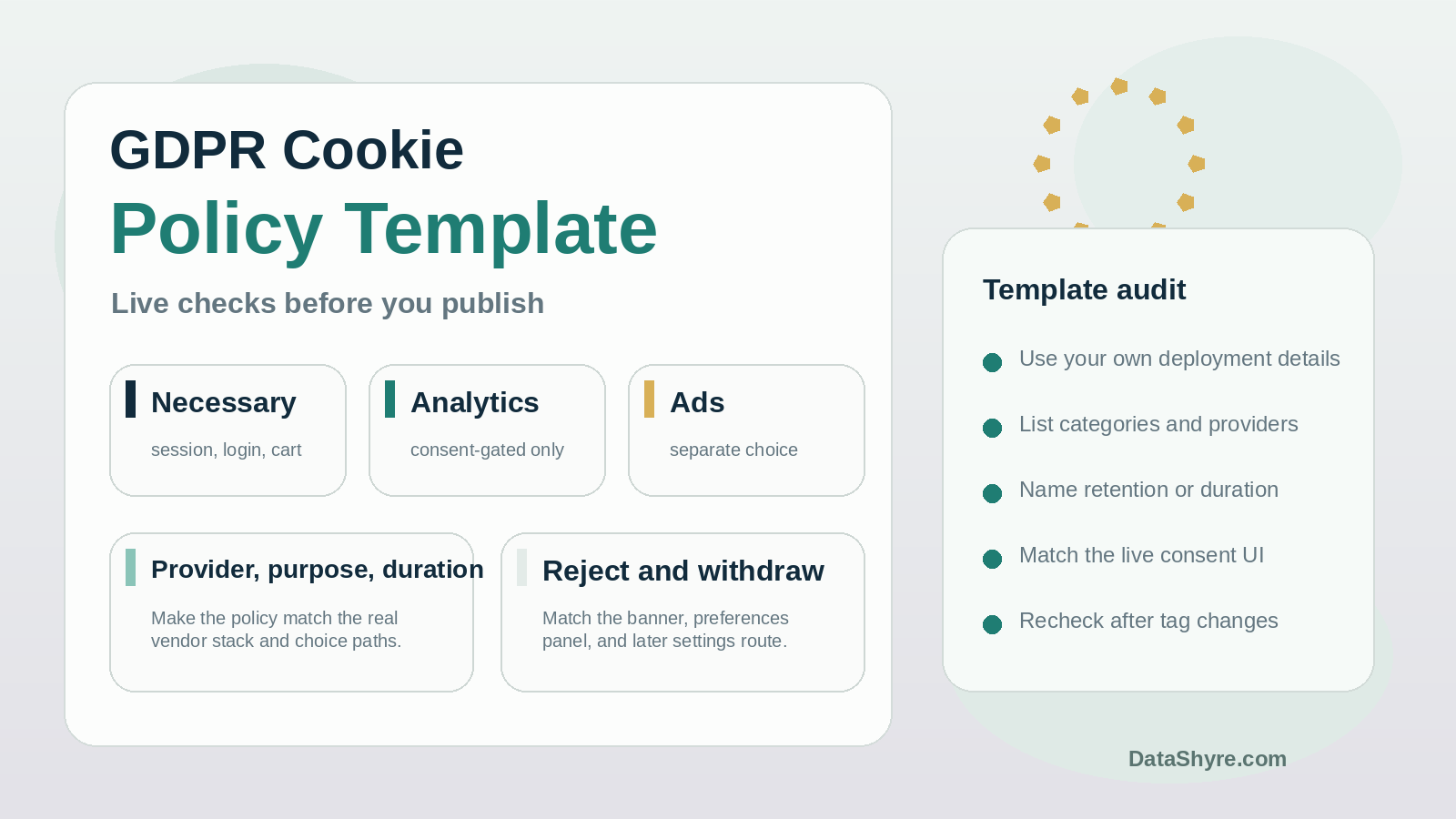
2. Make the template name categories, purposes, providers, and duration
A weak gdpr cookie policy template usually sounds polished but says very little.
The user gets broad labels like analytics or preferences, but not enough detail to understand what is happening.
Your Europe still expects clear and comprehensive information about the cookies used on the website and their purpose. In real deployments, a useful template should help you explain:
- the category of the technology;
- the practical purpose it serves;
- whether your company or a third party sets it;
- whether it is session-based or persistent; and
- where the user can manage the related choice later.
If those details are missing, the page is closer to a glossary than a real disclosure.
3. Classify necessary versus optional technologies narrowly
This is where many gdpr cookie policy template pages stop being reliable.
EU guidance still treats the exemptions narrowly. Cookies used only for transmission or strictly necessary to provide the service the person explicitly requested can sit in a different bucket from analytics, advertising, personalization, social, or cross-site tracking.
So before you publish a gdpr cookie policy template, classify the live stack into practical groups like:
- authentication, security, and session continuity;
- shopping basket or form-completion support;
- analytics and measurement;
- advertising and retargeting;
- personalization;
- embedded video, maps, chat, or social tools.
If optional tracking keeps getting renamed as necessary, the rest of the policy will usually drift too.
4. Write about your own deployment, not the vendor’s generic story
This is one of the best current checks because the DPC states it plainly: the information in the cookie policy or linked from the banner must describe the operator’s own deployment and use of cookies.
That means a gdpr cookie policy template should not lean on:
- a CMP vendor’s stock description page;
- a plugin author’s generic legal text;
- a law-firm sample that assumes a different stack; or
- a third-party help article about cookies in general.
If your cookie policy links users to somebody else’s general explainer instead of telling the truth about your own setup, the template has not done its job.
That is also where DataShyre can help if your team is stuck reconciling a CMP export, a vendor list, and the live website into one accurate operator-specific policy.
5. Match the template to the banner, reject path, and withdrawal path
A gdpr cookie policy template cannot be correct by itself.
It has to match the actual choice flow.
Your Europe still says withdrawal should be as easy as acceptance. The DPC still says pre-checked boxes or toggles do not produce valid consent. So when I review a gdpr cookie policy template, I compare it against:
- the first-layer banner copy;
- the
acceptandrejectpaths; - the category labels in the settings panel;
- the later
manage cookiesorprivacy settingsroute; and - the runtime behavior after the user changes their mind.
If the page says users can withdraw at any time but the route is buried or broken, the template is promising more than the interface delivers.
6. Cover more than classic cookies
This matters more in 2026 than it did a few years ago.
The ICO’s finalized guidance now uses “storage and access technologies” specifically because the modern stack is wider than classic cookie files alone. Its guidance explicitly includes scripts and tags, tracking pixels, fingerprinting, and web storage.
That means a serious gdpr cookie policy template should usually account for:
- cookies;
- local or session storage;
- scripts and tags;
- tracking pixels or beacons;
- embedded third-party tools; and
- other technologies that store or access information on the device.
If the page only works for a simple brochure site, it may fail as soon as the real stack includes tag managers, embeds, or ad-tech tooling.
7. Add update triggers so the template stays true after launch
The biggest long-term gdpr cookie policy template risk is drift.
The page can be accurate on launch day and wrong next week because:
- a new marketing vendor is added;
- the tag manager changes;
- a plugin update introduces a new script;
- the CMP categories are renamed;
- an embed starts setting new identifiers; or
- the reject or withdrawal flow changes.
This is why the template should trigger a re-review whenever the live tracking stack changes, not only when someone remembers to revisit legal pages on the calendar.
A practical GDPR cookie policy template review for this week
If you were reviewing a gdpr cookie policy template today, I would do the work in this order:
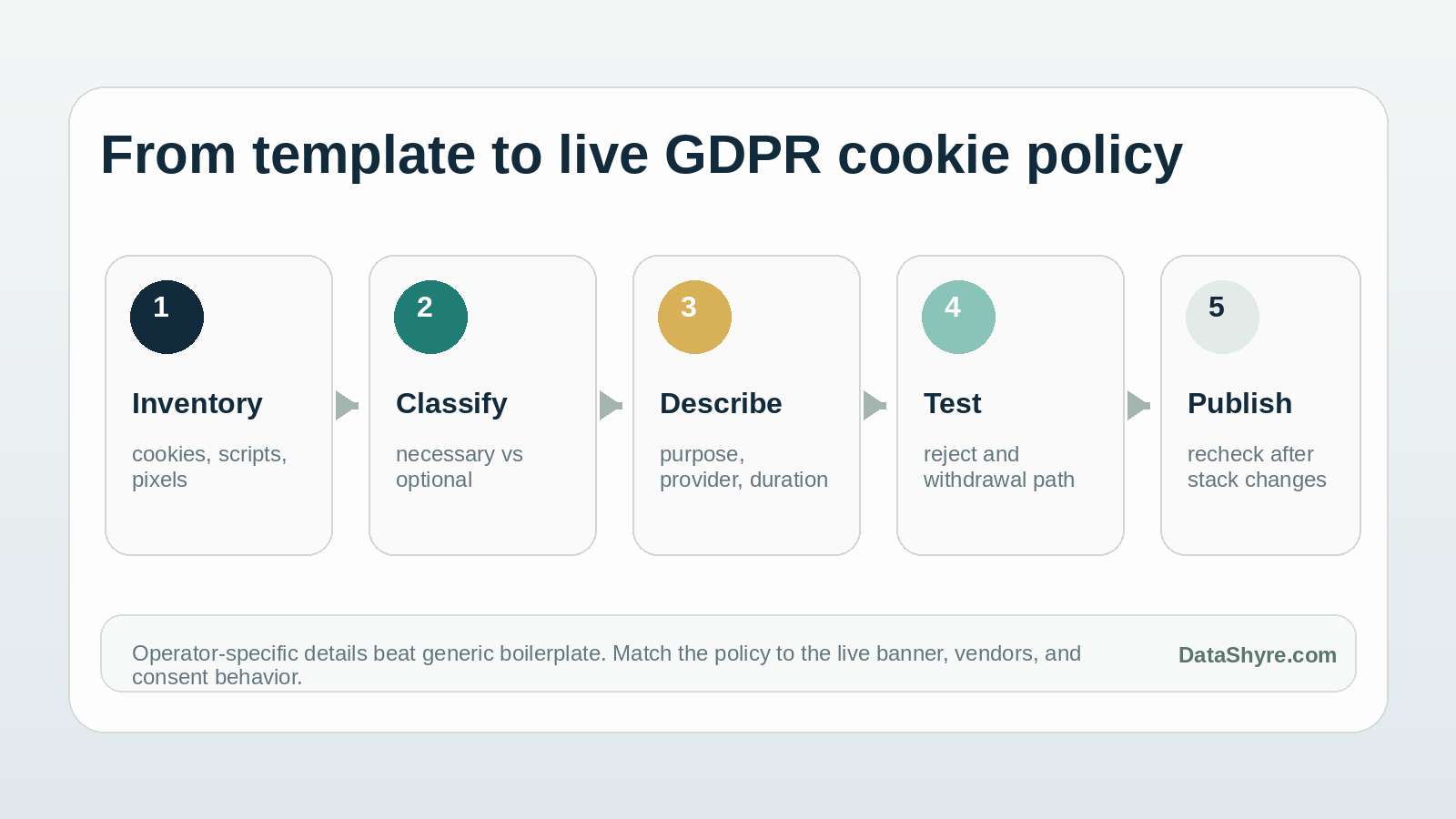
- inventory the live technologies on a clean page load;
- separate necessary functions from optional tracking;
- document category, purpose, provider, and duration;
- verify the operator-specific description against the real stack;
- test acceptance, rejection, and later withdrawal; and
- set a new review trigger before the next vendor or tag release.
That order usually catches more truth than polishing the wording first.
FAQ
Is a GDPR cookie policy template enough by itself?
No. A gdpr cookie policy template can speed up drafting, but it cannot verify what the live website loads, who receives data, or whether rejection and withdrawal actually work.
What should a GDPR cookie policy template include?
At minimum, it should help you describe categories, purposes, providers, duration, third-party involvement, consent logic, and how users can change their choices later.
Can I publish the text from my CMP vendor as-is?
Usually not. Vendor output can help, but the DPC’s current position is that the information should reflect your own deployment and use of cookies. That means you still need an operator-specific review.
Bottom line
The best gdpr cookie policy template in 2026 is not the one with the most boilerplate.
It is the one that matches the real stack, names the real purposes and providers, explains the real choice path, and still reads truthfully after the next release.
Seen clearly, gdpr cookie policy template is less about a pop-up and more about whether the site behaves honestly after the visitor makes a choice.
Official sources used
- https://eur-lex.europa.eu/eli/reg/2016/679/oj/eng/
- https://europa.eu/youreurope/business/growing/digitalising/online-privacy/index_en.htm
- https://dataprotection.ie/en/faqs/cookies/what-are-common-problems-dpc-sees-websites-and-other-interfaces-controlling-use-cookies-and-tracking
- https://dataprotection.ie/en/faqs/cookies/my-website-or-app-uses-cookies-and-other-tracking-do-i-have-get-consent-users
- https://ico.org.uk/for-organisations/direct-marketing-and-privacy-and-electronic-communications/guidance-on-the-use-of-storage-and-access-technologies/what-are-storage-and-access-technologies/